A near-black product page for a serverless Postgres with vector search, in the register of Neon, PlanetScale and Supabase: a light-strand hero with an install command and four figures, numbered chapters (01 Query with a real SQL console, 02 Branch with a branch graph and CLI session, 03 Replicate with the replication helix and an 18-region lag ledger), a benchmark with its method, photographed NVMe hardware beside a spec sheet, a customer quote, a plan table with usage rates and compliance, an FAQ and a closing terminal.
Infra & dev-tool teams launching a technical product page
Rows, embeddings and full-text in one database, replicated to the region nearest each user. Branch it per pull request and let it scale to zero when nobody is querying.
One query for rows, vectors and text. Filter by tenant, join your tables and rank by embedding distance in a single SQL statement, with no second database to keep in sync.
search.sqlexplainmain · fra1 read replica
public
docs 2.1M
id uuid
tenant_id uuid
title text
embedding vector(1536)
body_tsv tsvector
tenants 8.4k
orders 14M
events 310M
-- hybrid search: filter, join, rankSELECT d.id, d.title, t.name AS tenant, d.embedding <=> $1 AS distanceFROM docs dJOIN tenants t ON t.id = d.tenant_idWHERE d.tenant_id = $2AND d.body_tsv @@ websearch_to_tsquery('refund policy')ORDER BY distanceLIMIT 4;
id
title
tenant
distance
7f2c…a91e
Refunds for annual plans
Northwind
0.1184
b03d…11f7
Partial refund on downgrade
Northwind
0.1427
42e9…c0d2
Chargebacks and disputes
Northwind
0.1893
e81a…5b36
Cancelling within 14 days
Northwind
0.2051
4 rows in 8.2 msindex scan: hnsw_docs_embedding2.1M rows searched
Vectors are a column type.
Store embeddings next to the rows they describe. HNSW and IVF indexes, filtered search and transactions included.
Full-text in the same plan.
tsvector, trigram and BM25 ranking combine with vector distance in one ORDER BY, so hybrid search needs no glue code.
Connect over TCP or HTTP.
Any Postgres driver, or the HTTP driver for edge functions where sockets are not available. Pooling is built in.
Branch
02
Branch the database like code. Every pull request gets a copy-on-write branch of production, schema and data, in under a second. It is deleted when the PR merges.
branches · acme/storefront3 active
terminalstrandline 4.0.2
$ strandline branch create pr-482 --from main
✓ branch pr-482 ready in 640 ms(41 GB, copy-on-write)$ strandline migrate --branch pr-482
✓ applied 0047_refund_reason.sql
$ strandline diff main pr-482
+ ALTER TABLE refunds ADD COLUMN reason text; 0 rows rewritten · safe to merge$
Replicate
03
Reads served from the region nearest each user. Writes commit on one Raft leader and replicate to every region you choose, inside an 80 ms budget.
Replica lag behind leader iad18 / 18 in sync · budget 80 ms
iadleaderAshburnwrites
ordChicago9 ms
yyzToronto12 ms
sjcSan Jose31 ms
gruSão Paulo58 ms
lhrLondon37 ms
cdgParis39 ms
amsAmsterdam41 ms
frayouFrankfurt38 ms
madMadrid46 ms
arnStockholm52 ms
jnbJohannesburg71 ms
bomMumbai68 ms
sinSingapore74 ms
nrtTokyo66 ms
icnSeoul70 ms
sydSydney77 ms
hkgHong Kong72 ms
Benchmarks
Latency, measured. Against a tuned single-region Postgres on the same hardware class.
StrandlineSingle-region Postgres 17
Method: client in Frankfurt, single-region primary in us-east-1, 1M-row table, median of five runs, October 2026. Scripts and raw results
Point read, same regionSELECT by primary key13× faster
Strandline 3.1 msSingle-region Postgres 41 ms
Read across continentsp99, client in Frankfurt16× faster
Strandline 12 msSingle-region Postgres 186 ms
Vector top-101M rows × 1536 dims, HNSW12× faster
Strandline 8 msSingle-region Postgres 96 ms
Cold start from zerofirst query after idle105× faster
Strandline 40 msSingle-region Postgres 4,200 ms
Infrastructure
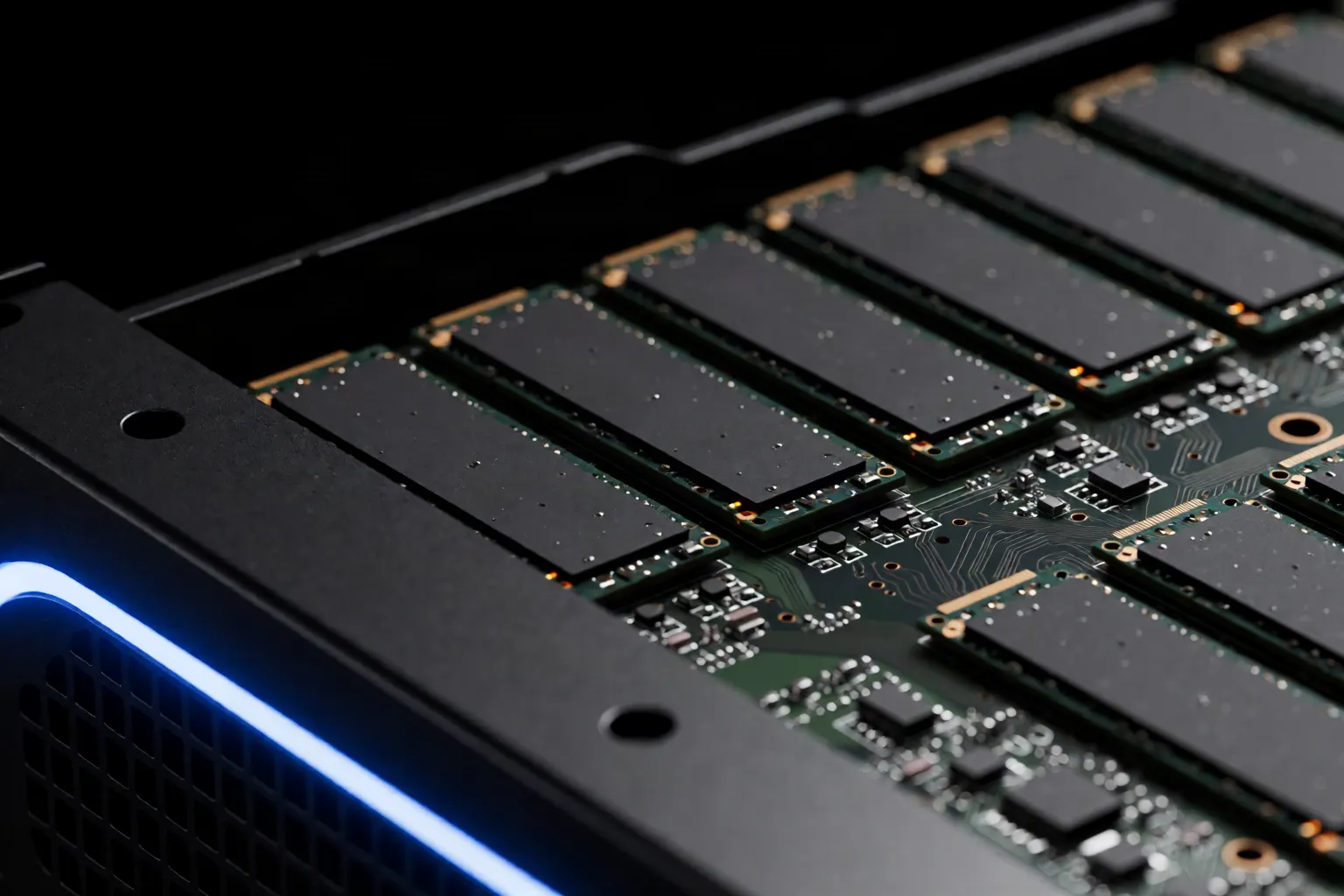
Local NVMe, not network disks. Every replica runs on directly attached flash, with the write-ahead log streamed to object storage so nothing depends on one machine.
1.2M IOPS per nodeGen4 NVMe, three replicas per region
18 regionsTier III+ facilities, five continents
Engine
Postgres 17 wire protocol
Isolation
Serializable by default
Durability
WAL to object storage every 200 ms
Restore
Any second in the last 30 days
Encryption
AES-256 at rest, TLS 1.3
Connections
10,000 pooled per database
Customer
“We had Postgres in Virginia and a vector store in Oregon, and a sync job between them that paged us twice a month. Moving both onto Strandline took a weekend. The sync job is gone, and so are the pages.”
Mara Okafor · Staff engineer, Lattice Freight
11×lower p95 for EU users
−62%monthly database bill
2 → 1databases to operate
Pricing
Pay for compute while it runs. Idle databases scale to zero, and storage is billed once however many regions read it.
Beyond the plan: compute $0.14 / CU-hourstorage $0.35 / GB-monthread replicas billed as compute per regionegress free up to 100 GB
SOC 2 Type IIReport on request
ISO 27001Certified since 2025
HIPAABAA on Scale and up
GDPREU-only data residency
FAQ
Before you migrate.
Is it actually Postgres?
It speaks the Postgres 17 wire protocol and SQL dialect, so psql, pg_dump, Prisma, Drizzle and every Postgres driver connect unchanged. Vectors use the same operators as pgvector (<->, <=>, <#>), so existing queries keep working.
How do I move an existing database over?
Run strandline import with your current connection string. It takes a consistent snapshot, streams changes with logical replication until you cut over, and keeps the old database untouched.
What happens when a region goes down?
Reads fail over to the next-nearest replica automatically. If the leader region fails, a replica that has acknowledged every committed write is promoted, typically within 9 seconds, and no committed write is lost.
Which extensions are supported?
pgvector-compatible vectors, PostGIS, pg_trgm, pgcrypto, uuid-ossp, hstore, citext and pg_stat_statements, plus 40 more. The full list is in the docs.
Can it run in our own cloud account?
Yes, on Enterprise. Strandline deploys the data plane into your AWS or GCP account; we operate it, and the data never leaves your account.
A database in 300 ms. Free to start.
No card, no instance size to pick. Create it from the CLI or the dashboard and connect with the driver you already use.
$ npx strandline create my-app --region fra
✓ database my-app created in 284 ms leader fra1 · replicas: none yet$ strandline replicas add iad sin
✓ 2 replicas in sync (lag 38 ms, 74 ms)$ strandline connect --print
postgres://app@fra1.strandline.example/my-app$
About Strandline. A serious database product page: black, exact and quiet, every claim backed by a query, a number or a photograph of the hardware.
Strandline sells a Postgres-compatible edge database with native vectors to backend and infra engineers, the people who decide on a latency table, a failure story and a price per unit. It follows the database-infrastructure leaders (Neon, PlanetScale, Supabase, ClickHouse): near-black ground, a large white headline whose second sentence turns grey, white pill buttons, mono eyebrows and ghost chapter numerals, and real product surfaces rather than illustrations. The hero pairs the headline and an npx command with a long-exposure photograph of two light strands, amber and blue, twisting into a helix. Three numbered chapters show the product working: a SQL console with a schema tree, a hybrid filter-join-rank query and its result grid; a branch graph beside a CLI session that creates, migrates and diffs a branch; and the replication helix (a data packet travels the leader strand) over an 18-region ledger of lag behind the leader. Then a benchmark against single-region Postgres with bars and its methodology, studio photography of the NVMe hardware and a data hall beside a spec sheet, one customer quote with three outcomes, a Free / Launch / Scale / Enterprise table (stacked cards on phones) with usage rates and compliance, an FAQ and a closing terminal session.
Colours and type. The palette, fonts and corners every page of Strandline is drawn from.
The system, applied to any site. Every rule below travels with the template — describe your tweaks and the agent keeps the system intact.
What it decides for you
Sell it the way the database-infrastructure leaders do (Neon, PlanetScale, Supabase, ClickHouse): near-black page, a large white headline, product surfaces instead of illustrations, numbers with their method, and plain pricing. Nothing playful, no mascots, no gradient text, no glow blobs.
Statements are written white-then-grey: the first sentence of each chapter heading in text colour, the explanation that follows in muted, at the same size (Geist 500, -0.035em tracking).
Chapters are numbered: a mono uppercase eyebrow with a small amber play-mark, a large ghost numeral (01, 02, 03) in the left column, the statement in the right three quarters.
Show the product: a SQL console (schema tree, line-numbered SQL, result grid, status line), a branch graph beside a real CLI session, a replica ledger, a benchmark with bars and a "×" factor per row, and a closing terminal. Every figure in tabular Geist Mono.
One sodium-amber signal accent (#F2B35E, deliberately not the green the incumbents own) for the leader node, the read path, distances, factors and the "you" region; steel blue (#8AB4FF) for write paths, replica lag bars and the second helix strand. Buttons are pills: white primary, outlined secondary.
The replication helix is the signature: two SVG strands crossing at region nodes (iad leader, fra, sin, gru, syd) with one data packet on a CSS offset-path; the hero photograph repeats it as twisting light strands, and the logo mark is the helix in both inks.
Photography is dark studio and architectural: light strands, NVMe storage hardware, a data-hall aisle. Generate it; never hot-link stock photos, never show a real vendor's hardware or logo.
Colours come only from the --ca-* tokens and color-mix(); layout uses container queries; all motion (packet, hero drift, cursor) stops under prefers-reduced-motion.
Ships with
Mono announcement bar ("Strandline 4.0: vector search is generally available") and a sticky blurred nav: helix logo, Product / Docs / Pricing / Customers / Changelog, GitHub stars, Log in and Sign up pills
Hero: eyebrow, "Postgres at the edge, with vectors built in.", lede, white "Start for free" and outlined "Read the docs" pills, an npx command box, a light-strand helix photograph fading in from the right, and four figures under a hairline
01 Query: white-then-grey statement, a SQL console (schema tree with the vector column highlighted, hybrid filter-join-rank SQL using <=>, result grid with distances, status line), three short capability notes
02 Branch: statement, a branch graph (main, pr-482 merged with a migration, pr-487 preview, a restore point) beside a CLI session that creates, migrates and diffs a branch
03 Replicate: statement, the replication helix with a travelling packet, an 18-region ledger of lag behind the iad leader (fra marked as you)
Benchmarks: statement, legend and method on the left; four rows with Strandline and single-region Postgres bars and an "N× faster" factor
Infrastructure: "Local NVMe, not network disks." with an NVMe hardware photograph, a data-hall photograph and an engine / isolation / durability / restore / encryption / connections spec sheet
Customer quote with three outcome figures; pricing table (Free, Launch, Scale "Most picked", Enterprise) that becomes stacked cards on phones, usage rates and four compliance cells; FAQ; closing headline with a terminal session; four-column footer with a status line
Keep looking. More from the library, developer first.